
٦ مايو ٢٠٢٦ م
How To Pass RTA Road Test
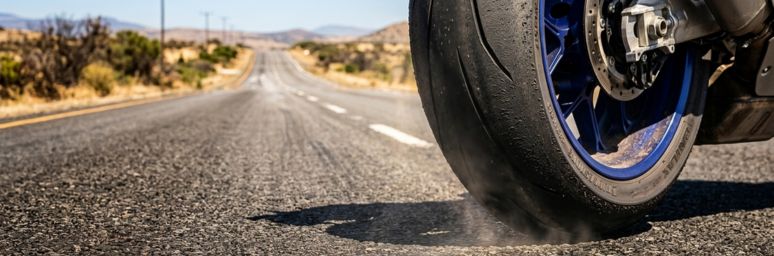
Motorcycle tyre grip is not determined by tread pattern or compound alone. The temperature of the riding surface plays a critical role in how effectively a tyre adheres to the road. In hot climates and peak summer conditions, asphalt temperatures can rise significantly above ambient air temperature, directly influencing traction, tyre pressure, wear patterns, and overall handling stability. From a physics standpoint, grip is governed by the coefficient of friction between the rubber and the pavement, and this value changes as temperature alters the tyre’s viscoelastic properties and friction coefficient variation. For riders who operate daily in high-temperature regions or during extended highway travel, understanding how hot asphalt affects motorcycle tyre grip is essential for maintaining safety, road safety, and performance optimization.
Tyres are engineered to function within specific thermal ranges known as the thermal grip threshold. When road temperatures increase, they accelerate the heating process of the rubber compound and influence its flexibility, elasticity, and contact behavior. At a molecular level, the performance of rubber polymers depends on remaining above their glass transition temperature, where they retain elasticity rather than becoming brittle. This behavior is also influenced by the rubber elasticity curve, which defines how compounds react across temperature ranges. While moderate warmth can improve traction by softening the compound, excessive heat may lead to thermal degradation, compromising structural stability and reducing predictable handling. This article explores the science behind tyre-road interaction, explains the impact of elevated asphalt temperatures on grip, and outlines practical measures riders can implement to maintain optimal control and climate adaptation.
Motorcycle tyre grip is the result of a complex interaction between rubber compounds and road surface texture. Grip is generated through two primary mechanisms: mechanical keying and molecular adhesion. Mechanical keying occurs when the tyre conforms to the microscopic roughness of asphalt, including its microtexture and macrotexture, creating frictional resistance. Adhesion refers to the chemical bonding effect between the rubber and the road surface. Both mechanisms depend heavily on temperature and directly influence overall road surface friction and road adhesion coefficient.
Rubber compounds used by manufacturers such as Michelin and Bridgestone are formulated with materials like silica compound blends and carbon black to optimize wear resistance and heat tolerance. These materials enhance the tyre’s hysteresis, which is the energy loss that occurs as rubber flexes and recovers during rotation. This also contributes to the heat dissipation rate, which determines how quickly a tyre can release accumulated heat. Below the intended operating window, the compound remains too rigid to properly conform to road irregularities. Above it, the compound may become overly soft, exceeding its rubber compound softening point, reducing structural integrity and accelerating wear. On motorcycles, where the contact patch is relatively small compared to cars, maintaining proper thermal balance is especially important because contact stress is concentrated over a limited area and influenced by contact patch pressure distribution.
The contact patch of a motorcycle tyre is a limited surface area responsible for transmitting acceleration, braking, and cornering forces. As asphalt temperature rises, heat transfers into the tyre through direct contact and friction, influenced by the pavement’s thermal conductivity and pavement composition, including the bitumen binder and exposed surface aggregate. This creates a surface temperature gradient between the tyre exterior and internal structure. This increases internal air pressure through thermal expansion and softens the rubber compound. While some degree of softening enhances grip, excessive heat can alter deformation characteristics, increase sidewall flex, and compromise feedback to the rider.
Many riders assume that air temperature determines riding conditions. In reality, asphalt temperature can be significantly higher than the surrounding air. On a 40°C day, road surfaces can easily exceed 60–70°C, especially on dark, dense pavement exposed to direct sunlight. Urban environments with heavy traffic further increase surface temperature due to residual heat retention and limited airflow, contributing to ambient heat load.
Asphalt absorbs and retains solar radiation efficiently because of its composition and density. The presence of a petroleum-based bitumen binder increases heat absorption. Unlike air temperature, which fluctuates with wind, air density, and shade, asphalt temperature remains elevated for extended periods. This sustained exposure creates a continuous heat-induced tyre fatigue cycle. Ambient humidity also influences heat perception and minor cooling effects, but it does not substantially reduce pavement heat.
When a motorcycle travels over overheated pavement, the tyre experiences external heat input in addition to the heat generated internally from flexing and friction. This dual heating effect accelerates internal temperature rise within the tyre carcass, affecting structural rigidity and increasing rolling resistance. The result may include reduced grip consistency, premature wear, altered handling response, and elevated internal pressure due to the pressure–temperature relationship defined by basic gas laws and influenced by slip ratio dynamics.
Heat is not inherently detrimental to motorcycle tyres. In fact, moderate heat is essential for optimal performance. Performance and sport-oriented tyres are specifically designed to operate at elevated temperatures, where the compound becomes pliable enough to maximize surface contact. In controlled racing environments, tyres are preheated to ensure that the rubber reaches optimal elasticity before experiencing aggressive shear forces during cornering, improving riding efficiency.
When rubber reaches its designed operating temperature, it becomes more elastic and better able to conform to road irregularities. This improves the effective contact area and increases the coefficient of friction between tyre and asphalt. Braking stability improves, cornering feels more predictable, and acceleration traction becomes more responsive. Advanced rider aids such as traction control systems and ABS perform more effectively when the tyre maintains consistent grip characteristics and optimal compound resilience.
Excessive asphalt temperature introduces several performance and safety concerns. When the rubber compound becomes too soft, it may deform excessively under load, increasing dynamic load transfer effects during braking and acceleration. This deformation leads to tyre tread block deformation, reducing structural stability during high-speed cornering.
Overheated tyres are more susceptible to accelerated wear and oxidative aging, particularly when repeated heat exposure breaks down molecular bonds within the rubber polymers. This contributes to reduced tyre lifespan and long-term performance degradation.
Another critical factor is tyre pressure fluctuation. As internal air temperature increases, pressure rises through thermal expansion. Overinflation reduces the size of the contact patch, increasing contact stress and diminishing traction despite the softened compound. This imbalance affects performance optimization and may lead to unpredictable handling behavior.
Not all motorcycle tyres respond to heat in the same way. Touring tyres are typically formulated with harder compounds and reinforced structures to handle sustained highway speeds and higher load rating demands. These tyres may tolerate elevated asphalt temperatures better than ultra-soft sport compounds designed for maximum lean-angle grip, especially in climate-specific riding conditions.
Manufacturers such as Pirelli and Dunlop design multi-compound tyres to balance durability and performance. Advanced designs now incorporate nano-compound technology and advanced polymer engineering to improve heat resistance and adaptability.
Tyre construction also influences heat management. Radial tyres generally dissipate heat more efficiently than bias-ply designs because of their internal belt configuration and improved heat dissipation characteristics. This contributes to better heat management systems within the tyre structure.
Hot asphalt affects each dynamic aspect of motorcycle control differently. Under braking, excessive tyre softness increases tread movement and alters the tyre’s coefficient of friction, potentially extending stopping distances and impacting emergency braking response.
During cornering, heat-induced softness may initially enhance grip but eventually compromise structural consistency if the compound surpasses optimal elasticity. Elevated temperatures increase shear forces at the contact patch, especially during aggressive lean angles.
High-speed highway riding introduces sustained thermal exposure, affecting fuel efficiency due to increased rolling resistance and heat buildup.
Repeated exposure to extreme asphalt temperatures accelerates the ageing process of rubber compounds. Heat contributes to oxidation, compound stiffening, and gradual loss of elasticity. This leads to reduced grip, increased wear, and compromised riding efficiency.
Heat cycles alter molecular bonds and can influence the tyre’s compound curing stability over time. This results in cumulative heat-induced tyre fatigue and structural weakening.
Regular inspection becomes particularly important in hot climates. Monitoring for uneven wear, sidewall cracking, discoloration, or surface irregularities ensures timely replacement and sustained road safety.
Moderate heat improves grip by optimizing the tyre’s coefficient of friction and elasticity. However, excessive temperatures can lead to thermal degradation and reduced traction consistency.
Asphalt can be 20–30°C hotter than ambient air temperature due to solar absorption and pavement composition, particularly the presence of bitumen binder./p>
Tyre pressure should always follow manufacturer specifications. Because of the pressure–temperature relationship, pressure naturally increases in hot conditions, and underinflation can increase overheating risk.
Sport tyres tolerate higher operating temperatures but may overheat more quickly on extremely hot pavement. Touring tyres often provide better sustained heat resistance due to compound durability and higher load rating tolerance.
Common signs include rapid tread wear, reduced braking precision, excessive pressure rise, surface tearing, or subtle signs of oxidative aging and compound softening. Regular inspection ensures early detection of heat-related issues.