
٦ مايو ٢٠٢٦ م
How To Pass RTA Road Test
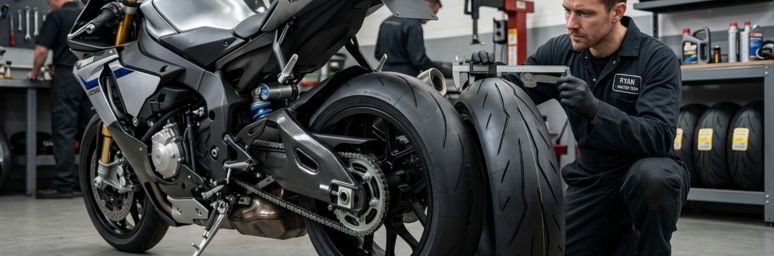
Upsizing motorcycle tyres is a common modification among riders who want enhanced aesthetics, improved grip, or altered riding characteristics. However, changing tyre dimensions is not a purely cosmetic decision. Tyres are engineered as an integral part of a motorcycle’s chassis geometry, suspension design, braking system, and overall performance balance. When you alter tyre width, aspect ratio, or rim compatibility, you influence multiple interconnected mechanical systems, including steering input effort, moment of inertia, and overall cornering stability. Additionally, tyre behavior is also influenced by tyre compound, tread pattern, and carcass construction, which determine how the tyre interacts with different road surface types and riding conditions.
Manufacturers such as Michelin, Bridgestone, and Pirelli design tyres according to strict load index, speed rating, and homologation standards. These specifications align with detailed manufacturer specifications and official OEM fitment charts developed during vehicle testing and ECU calibration processes. Ignoring these technical parameters can compromise handling stability, cornering precision, braking distance, and even structural safety. Even subtle changes in tyre profile shape or sidewall stiffness can disrupt the carefully balanced dynamics of the motorcycle platform. Furthermore, incorrect sizing may accelerate thermal degradation and reduce overall tyre lifespan due to improper heat dissipation.
Before evaluating upsizing, it is essential to understand how motorcycle tyre sizing works. A typical tyre marking such as 120/70 ZR17 includes three critical components: width (120 mm), aspect ratio (70%), and rim diameter (17 inches). The aspect ratio determines the tyre’s sidewall height as a percentage of its width, which directly affects ride comfort, flex characteristics, and lean behavior. It also influences sidewall stiffness, tyre deformation, and overall contact patch pressure distribution under dynamic load, including camber thrust and slip angle behavior during cornering.
Motorcycle tyres also carry a load index and speed rating. The load index indicates the maximum weight the tyre can support under controlled inflation pressure and determines overall tyre load capacity. The speed rating represents the maximum safe operating speed under specified testing conditions. These ratings are part of international safety compliance standards and vehicle homologation requirements, ensuring structural durability even under tyre heat cycle stress and sustained high-speed operation. Additionally, dynamic tyre pressure variation during riding significantly affects grip, stability, and rolling resistance coefficient.
Motorcycle manufacturers calibrate suspension travel, steering rake and trail, wheel alignment, and braking geometry based on the OE tyre size. Even a small deviation in tyre diameter can alter the rolling circumference, impacting speedometer accuracy, gear ratio perception, and electronic rider aids such as ABS (Anti-lock Braking System) and traction control systems. Modern systems also rely on precise speed sensor calibration tolerance, and altering tyre diameter can affect ECU calibration, especially in motorcycles equipped with a tyre pressure monitoring system (TPMS).
Upsizing refers to installing a tyre that is wider, has a taller sidewall, or both, compared to the manufacturer-recommended specification. Riders commonly consider increasing rear tyre width for a more aggressive appearance or improved straight-line traction. In some cases, front tyre upsizing is attempted for perceived stability or improved straight-line tracking, particularly under highway cruising conditions or long-distance touring scenarios.
However, upsizing does not simply add rubber to the road. It modifies the tyre footprint, tyre profile shape, sidewall flex dynamics, unsprung weight, and rotational mass. These changes increase moment of inertia and influence the gyroscopic effect generated by rotating wheels. As a result, throttle response, steering feedback, and high-speed stability are directly affected. Even countersteering response may feel slower due to increased rotational resistance, and lateral stiffness variation may alter rider confidence during aggressive lean angles.
Motorcycles rely heavily on precise steering geometry. A taller tyre increases ride height, potentially altering ground clearance and causing subtle wheelbase variation depending on axle positioning. These changes affect rake and trail geometry, influencing agility and straight-line stability.
A wider rear tyre may flatten the tread profile and increase the surface area of the tyre footprint. While this can improve traction in acceleration phases, it may reduce responsiveness during corner initiation. Riders may notice heavier steering input, slower lean transitions, and altered countersteering feedback. On sport motorcycles, this can disrupt front-to-rear grip balance and affect braking torque distribution during aggressive riding, especially under varying wet vs dry performance conditions.
Motorcycle suspension is tuned according to factory tyre dimensions and expected axle positioning. When tyre diameter increases, effective ride height changes, influencing sag settings, damping characteristics, and even rear shock linkage ratio geometry.
A heavier tyre increases unsprung mass and modifies how the suspension responds to road irregularities. Larger tyres may also impact front fork travel and alter compression dynamics during emergency braking. Without recalibrating suspension preload, compression, rebound damping, and chain slack adjustment, the motorcycle may experience unpredictable behavior under acceleration or corner exit. Additionally, improper setup can introduce tyre harmonics that negatively affect ride smoothness and stability.
Modern motorcycles use advanced braking systems and integrated electronics. These systems rely on accurate wheel speed data. Changes in rolling circumference can interfere with speed sensor calibration tolerance, potentially affecting ABS activation timing.
An altered rolling circumference may cause incorrect speedometer readings and influence traction control thresholds. In addition, changes in tyre diameter affect braking torque transfer through the wheel assembly. Increased rotational mass elevates stopping distance due to higher moment of inertia, even if the tyre width increases slightly. It can also increase rolling resistance, leading to reduced fuel efficiency over extended riding.
Physical clearance must always be verified before upsizing. A wider tyre must fit within the swingarm while respecting swingarm clearance tolerance, chain alignment, and rear fender space. Insufficient clearance may cause rubbing during suspension compression or under passenger load.
Installing a tyre on an incompatible rim width may distort the bead profile and alter sidewall flex behavior, especially affecting bead seating integrity. Ignoring proper fitment can lead to accelerated tyre wear rate, uneven wear patterns, overheating, and premature tyre squaring during highway riding.
Altering tyre size beyond manufacturer specifications may violate road safety compliance standards. Many jurisdictions require tyres to match official OEM fitment charts. Insurance providers may investigate modifications, especially after accidents involving high-speed instability or braking failure.
Instead of altering tyre dimensions, riders can improve performance by selecting tyres with advanced radial construction or bias-ply construction suited to riding style. Modern tyres with optimized carcass design and advanced tyre compound engineering offer superior grip without increasing size.
Upgrading to premium compounds improves traction, heat management, and durability without affecting geometry. Proper inflation pressure management ensures optimal contact patch pressure distribution, minimizing uneven wear and maximizing braking efficiency. Riders should also consider tyres optimized for wet vs dry performance balance depending on their typical riding environment.
Routine inspection of alignment, suspension tuning, and drivetrain condition provides greater performance benefits than dimensional changes alone. Professional installation and periodic inspection ensure consistent performance, safety, and long-term mechanical reliability.
Grip depends on compound, construction, and temperature management. A wider tyre changes the tyre footprint, but high-quality construction provides greater benefit than increased width alone.
No. Increased rotational mass and higher moment of inertia may slightly reduce acceleration and fuel efficiency./p>
It may be safe within tolerance limits, but changes can affect dynamic load transfer, chassis balance, and steering response.
Yes. Changes in rolling circumference can interfere with speed sensor calibration tolerance and ECU-controlled rider aids.
Choose tyres that match OEM specifications, verify manufacturer specifications, maintain correct tyre pressure, and ensure suspension calibration remains optimized.