May 6, 2026
How To Pass RTA Road Test
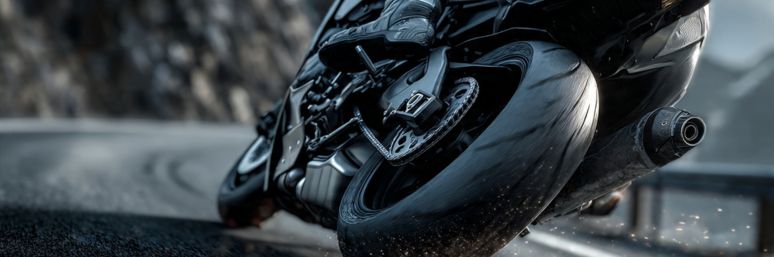
Tread pattern design plays a much larger role in motorcycle cornering performance than many riders assume. While aggressive grooves may appear purely aesthetic, they are actually engineered to control how a tyre interacts with the road surface under changing conditions. On dry roads, a tyre with minimal tread interruption can maintain a larger effective contact patch, allowing more rubber to interact with the asphalt and improving the overall coefficient of friction. This is why professional racing motorcycles often use slick tyres with no grooves at all.
However, real-world riding rarely happens in perfect conditions. Rainwater, dust, and road debris reduce traction and can cause a tyre to lose grip suddenly. In these situations, tread channels become essential because they help evacuate water away from the tyre footprint, preventing a dangerous phenomenon known as hydroplaning. Modern motorcycle tyres are designed with carefully engineered water evacuation grooves and variable tread block geometry to balance dry grip with wet-road stability. This balance ensures that riders maintain predictable cornering performance even when environmental conditions change rapidly.
Tyre pressure is one of the most overlooked yet critical variables affecting cornering grip. Even a small deviation from the manufacturer’s recommended pressure can dramatically change how a tyre behaves during leaning and cornering. When tyre pressure is too high, the tyre becomes rigid and the contact patch shrinks. This reduces the tyre’s ability to deform and conform to road texture, ultimately lowering available grip and making the ride feel harsh and unstable.
Conversely, running tyres with insufficient pressure creates excessive sidewall flex and uncontrolled deformation. While this may increase the apparent contact area initially, it leads to uneven pressure distribution across the tyre surface and can cause overheating. Excessive flex also destabilizes the tyre carcass structure, which negatively impacts steering precision and mid-corner balance. Maintaining proper tyre pressure ensures that the contact patch geometry remains stable and that the tyre can distribute forces evenly while cornering.
Temperature has a direct influence on the physical properties of rubber compounds used in motorcycle tyres. When tyres are cold, the rubber molecules remain stiff and less flexible, which limits their ability to deform and interlock with the microscopic texture of the road surface. As the tyre warms up through friction and movement, the compound becomes more elastic and capable of generating stronger mechanical grip.
This temperature-dependent behaviour explains why professional racers often rely on tyre warmers before entering the track. These devices bring the tyres into their optimal compound temperature range, ensuring that maximum grip is available from the first corner. On public roads, however, tyres gradually heat up during riding. Riders may therefore experience reduced traction during the first few minutes of a ride. It is also important to understand that excessive heat can degrade rubber performance through repeated tyre heat cycles, which gradually harden the compound and reduce its ability to generate friction.
Despite the complexity of motorcycle dynamics, the entire system ultimately depends on a surprisingly small area known as the contact patch. This is the portion of the tyre that physically touches the road at any given moment. For most motorcycles, the contact patch is roughly the size of a credit card, yet it must manage braking forces, acceleration loads, and lateral cornering forces simultaneously.
As the motorcycle leans into a corner, the contact patch shifts toward the tyre’s shoulder. During this process, the tyre undergoes controlled deformation that redistributes pressure across the rubber surface. Engineers often refer to this dynamic area as the tyre footprint, which constantly changes based on lean angle, load transfer, speed, and road conditions. The stability of this footprint is crucial because it determines how effectively the tyre can generate friction and maintain traction while the bike is leaned over.
Motorcycle tyres cannot perform effectively without proper suspension support. The suspension system controls how weight transfers across the motorcycle during braking, acceleration, and cornering. It also manages unsprung mass, allowing the tyres to maintain consistent contact with the road even when riding over bumps or uneven surfaces.
When suspension settings are too stiff, the tyres may lose contact with the road momentarily as the motorcycle skips over irregularities. This reduces grip and makes the bike feel unpredictable during cornering. On the other hand, suspension that is too soft allows excessive movement and instability, causing the motorcycle to feel vague and unsettled mid-corner. Properly balanced suspension ensures smooth dynamic load transfer, allowing tyres to maintain optimal contact pressure across the road surface. In simple terms, tyres provide grip, but suspension ensures that grip remains usable.
Many riders assume that wider tyres automatically provide better grip because they appear to offer a larger contact area. While tyre width can influence performance, it does not directly determine grip. The actual traction generated by a tyre depends more on the rubber compound, internal construction, pressure settings, and load distribution across the contact patch.
Installing tyres that are significantly wider than the manufacturer’s recommended specification can alter a motorcycle’s steering geometry and reduce agility. On lighter motorcycles, this change may even decrease cornering performance because the tyre profile becomes flatter and less responsive during lean transitions. The ideal tyre width is therefore one that maintains a balanced tyre footprint shape while preserving predictable steering behaviour and stability.
Selecting the correct tyre type is essential for achieving the best possible cornering performance. Different categories of motorcycle tyres are designed with specific riding environments and performance priorities in mind. For example, sport tyres prioritize maximum grip and lean-angle capability, making them ideal for aggressive riding or track use. These tyres typically feature softer rubber compounds that provide exceptional traction but wear more quickly.
Sport touring tyres offer a compromise between grip and durability. They are engineered to provide reliable performance over longer distances while still maintaining stable handling in corners. Riders who frequently travel on highways or take long trips often prefer this category because it balances performance with longevity. Adventure tyres, on the other hand, are designed for mixed terrain riding. While they provide versatility across gravel and dirt surfaces, their tread design and compound structure usually result in slightly reduced pure lateral grip on paved roads.
Many riders unintentionally reduce their available cornering grip through simple maintenance or riding errors. One of the most common mistakes is neglecting regular tyre pressure checks. Incorrect pressure alters the shape of the contact patch and reduces the tyre’s ability to distribute forces evenly during cornering. Another frequent mistake is mixing different tyre types or brands, which can create inconsistent handling characteristics because each tyre may respond differently to load and temperature.
Riding behaviour also plays a major role in traction. Abrupt throttle inputs, sudden braking, or aggressive steering movements can push the tyre beyond the limits of the traction circle, leading to a rapid loss of grip. Ignoring suspension setup or riding on tyres that have exceeded their compound life cycle further increases the risk of instability. Maintaining tyres properly and riding smoothly ensures that the available grip remains predictable and controllable.
Improving cornering grip does not always require expensive upgrades or new equipment. In many cases, riders can significantly increase available traction simply by paying attention to maintenance and riding technique. Checking tyre pressure regularly ensures that the contact patch remains stable and capable of distributing forces correctly. Inspecting tyres for uneven wear, sidewall damage, or hardened rubber compounds also helps identify problems before they affect performance.
Allowing tyres to warm up gradually before aggressive riding is another important habit. Smooth throttle application, progressive braking, and controlled steering inputs help keep forces within the tyre’s traction limits. When combined with properly balanced suspension settings, these small adjustments allow riders to maximize the grip potential of their existing tyres while maintaining safer and more predictable cornering behaviour.
Yes, in dry conditions and when properly warmed up. However, they wear faster and may not perform well when cold.
At least once a week and before long rides. Incorrect pressure drastically reduces grip./p>
No. Even if tread depth looks acceptable, aged or squared tyres significantly reduce lean stability and traction.
Not necessarily. Grip depends more on compound, temperature, and pressure than just width.
Typically 3–5 years depending on usage, storage, and riding conditions. After that, rubber hardens and grip declines.